Sustainability in Print: From Ambition to Action
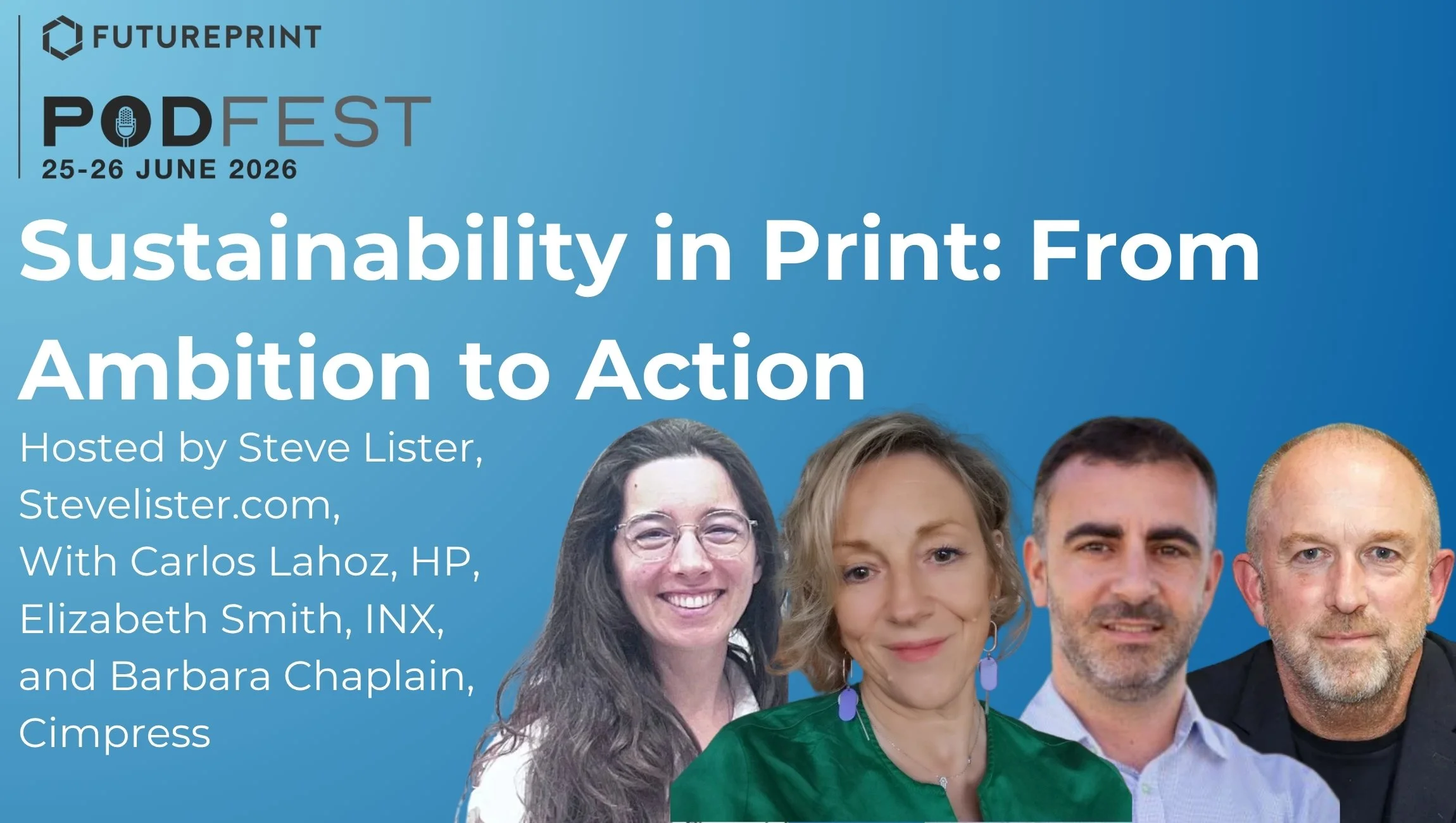
At the FuturePrint PodFest in June 2026, three sustainability leaders discussed what it really takes to make print more sustainable: managing challenging materials, working with data held in other peoples’ systems, and recognising that true progress depends on collaboration.
There's a version of the sustainability story that goes something like this: find the greener material, swap it in, carry on. This feels easy and reassuring, but according to the people who do this for a living, it's almost never true. Barbara Chaplain of Cimpress talks about a project that sounds very simple: moving banner products away from PVC. ‘It's not a simple material substitution,’ she said, and then spent the next few minutes explaining exactly why. Rather than look for a straight swap, Cimpress asked a better question: they went to hundreds of customers in multiple countries and asked what they actually needed the product to do. And found that plenty of long-standing assumptions didn't hold up.
Which led to the kind of detail that makes a materials person light up. PVC-free banners tend to be thinner and lighter, and every instinct says thinner means weaker. However, if you read the technical data sheets it will show that the opposite is true. It's a counterintuitive result: the thinner, lighter, more sustainable banner is actually the stronger one. But you only find that out by testing the assumption instead of trusting it. Today those PVC-free banners are live across five Cimpress businesses in fifteen markets, with, as Barbara happily admitted, plenty still to do.
It's decided before anything is printed
One statistic set the tone for the whole conversation. Around 80% of the environmental impact of any product or service (a figure from the Ellen MacArthur Foundation) is determined at the design stage. Most of the impact is set long before anything is printed.
For an industry that loves what it does to materials, the inks, the laminates, the embellishments, all the wonderful things we do to make print engaging, that's a slightly uncomfortable idea. The panel kept coming back to one point. You can put all that skill into a beautiful printed piece, and a recycler will turn round and say they can't recycle it. Not a failure of the product, just a dead end at the end of life.
The trade-off nobody escapes
Elizabeth Smith of INX lives in a world of packaging and ink systems that is a running lesson in compromise. Solve for food safety with low-migration inks, and you can create a problem with recyclability. Fix that, and something else shifts. ‘It's understanding what is critical,’ she said, ‘and what the compromises and the trade-offs are.’ The industry is starting to build cleverer answers, low-migration inks that are also nitrocellulose-free, so recyclability doesn't have to be sacrificed. However the honest position, for now, is that trade-offs are still part of the deal.
And they get harder because everyone in the value chain is optimising for something different. A printer's priorities aren't a waste manager's priorities. Balancing all of that, making a product that's genuinely as sustainable as it can be, rather than sustainable in one narrow way, is where the real difficulty lives. Sometimes, the panel noted, the answer isn't a new material at all. It's re-examining an old assumption. Do we actually need this level of colour? Ask that honestly, and the solution space suddenly gets bigger.
Nobody does this alone
If one word kept returning to the room, it was collaboration. Carlos Lahoz of HP simply said: this isn't something printers can crack on their own. The material manufacturers have to innovate and share; the equipment and ink makers have to make sure those materials actually run at the right quality, the right durability, the right price. HP's media certification programmes exist for exactly this reason: to do the testing up front, so a printer can trust that the material will work, every single time.
The issue here is also that having a new material, just isn't enough. It has to be available, it has to be affordable, and, this is the part people underestimate, someone has to be willing to put in the effort to change. That effort, Carlos noted, often comes not from mass demand but from a handful of leading companies with the vision to say: this is the way, and we'll do the hard part first.
You can't manage what you don't measure, so start small
From there the conversation turned, inevitably, to data. Carlos has a lovely phrase for the starting point: ‘low resolution numbers.’ You don't need perfect, fancy data to begin. You need some numbers, enough to make a decision, and you improve the picture as you go along. The data itself is scattered across systems, full of duplications and gaps, and, crucially, much of it isn't inside your own four walls at all. It's with your suppliers and your customers.
For anyone feeling daunted, and plenty are, the practical advice was refreshingly down to earth: start small. Begin with greenhouse gases, get your Scope 1 and 2 in order, then work towards Scope 3, then product carbon footprints. And measure more than one way. The take rate on that PVC-free banner looks different per square metre, per order, and per unit of revenue, and each angle tells you something new about what to do next.
Why the Manifesto exists
All of which explains where the Sustainable Print Manifesto came from. Carlos told the origin story: he started measuring, found that so many of the numbers lived outside his own business, and realised the only way to see the full picture (let alone improve it!), was to collaborate. When he checked with peers across the value chain, the need was confirmed. More than forty companies, some of them direct competitors, spent a year and a great many meetings agreeing on the fundamentals: nine principles for making print more sustainable. An anchor point everyone could start from.
But Carlos was clear about what the document is and isn't. ‘A document by itself doesn't change anything,’ he said. Its power isn't in the PDF; it's in the alignment: everyone asking for the same things, creating the volume and the market signal that actually moves suppliers to invest and innovate.’ The working group, he stressed, has always been vocal about one thing: they want action, not a declaration. And it's a live document, one that keeps evolving as the challenges do. For a printer staring at a blank page, it's structure. For one already well down the road, it's a way to raise the bar.
The strength in ‘I don't know’
One of the quieter themes was how much the culture has shifted. Not long ago, telling a customer ‘I don't know’ felt like weakness. In sustainability, it's become a strength. Product carbon footprint calculations are riddled with assumptions, some verified, some not, and the panel agreed that the brave, useful move is to go to a customer and say: this is what we're doing, is it right, does it meet your expectations? Nobody, they reckoned, has ever met that kind of honesty with anything but support.
Where it gets genuinely hard
Pushed on the biggest challenges, the panel didn't reach for easy answers. Balancing the whole value chain's competing requirements is the daily one: solving a problem here, creates one there. Then there's waste: the overproduction built into so many supply chains, and the end-of-life question sitting underneath everything. Carlos's favourite antidote is print on demand, produce only what's needed. However, end of life, he admitted, is the big horizontal gap, touching materials, production and recycling all at once.
Barbara put her finger on why recycling is so stubborn for our industry. The global recycling infrastructure was built for packaging such as milk bottles, water bottles, everyday FMCG. Print's products, especially the plastic-based ones, don't fit neatly into that system. Making them genuinely recyclable in practice, not just in theory, would take large-scale reverse logistics and closed-loop collaboration, which is the kind of thing no company can build alone. We're not there yet, she was honest enough to say. But naming it is where the work starts.
An optimist's future
People who work in sustainability tend to be optimists about the future, they almost have to be and Carlos is. His vision is very simplistic: in time, there will be no print that isn't sustainable. The innovators lead, the rest get drawn along, and sustainability stops being a differentiator at all. Like quality today, it just becomes the baseline. You might differentiate on it for the next five years or so. After that, it's simply how the industry works.
Getting there means designing sustainability in from the start, rather than bolting it on and discovering the problem at the end of the value chain. It means bracing for regulation, PPWR strengthening, roadmaps stretching to 2030, ad treating that as a reason to collaborate rather than panic. And it means letting sustainability stop being a department and becoming the business itself. Now, the panel agreed, is exactly the moment to set voluntary goals and embed them into procurement and into product design, before regulation makes them mandatory. Although we have heard many times that ‘print is dead’, we believe that it just keeps on growing, moving into new and different places. And sustainability, is
We've heard it said many times that print was dead. It never was. It just keeps growing, keeps moving into new places and sustainability is the next chapter in that story.
