Decarbonisation in Print
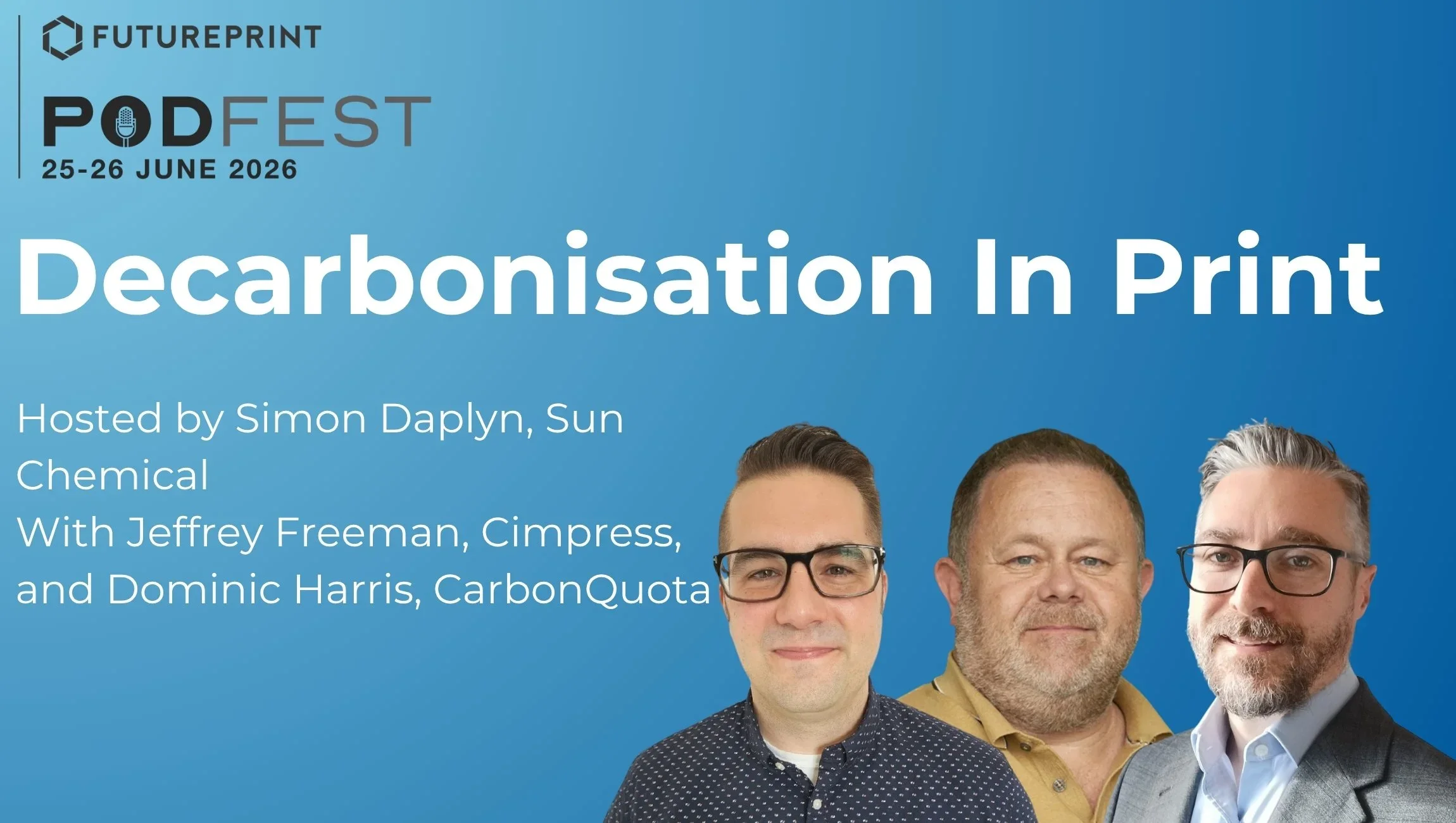
At FuturePrint PodFest, Simon Daplyn of Sun Chemical sat down with Jeff Freeman of Cimpress and Dominic Harris of CarbonQuota to cut through the noise around carbon: what it actually is, where it hides, and why the whole thing keeps coming back to three words.
Within a minute of sitting down, everybody in the room agreed on that fact that Carbon is a very complicated subject. It's technical, it's easy to get wrong, and there's a fair amount of misunderstanding floating around the industry. However, Dominic Harris of CarbonQuota can summarise what a company actually needs to do in three words: measure, reduce, measure.
‘It's a lot more complex when you actually have to do it,’ he added, which is the honest footnote to almost everything in this session. Carbon, as Dominic put it, is simply the gas that human activity pumps into the atmosphere, warming the planet. Open the fridge, start the car, board a plane, and you create emissions. And in our world it's no different: every plate, every litre of ink, every press start, every pallet of paper, every delivery. Print is part of the manufacturing world, and manufacturing emits. Our industry, he said plainly, is a big emitter. Which is uncomfortable, but it's also the reason this work matters.
Most of your carbon lives somewhere else
Jeff Freeman has been doing carbon accounting at Cimpress, the group behind Vistaprint and a long list of other brands, for nine years, and his journey will sound familiar to anyone who's started. You begin with Scope 1 and 2: the emissions inside your own four walls, your electricity and your direct fuels. Then you get to Scope 3, which is everything else. And for Cimpress, everything else turned out to be almost all of it: something like 97 to 98% of the entire footprint sits in Scope 3.
And there you have it, right there: The vast majority of your carbon isn't really yours to switch off. It's upstream and downstream, in your suppliers, in your materials, in how things travel and where they end up. Cimpress used rough, spend-based accounting first, just to look at the size of the problem, then spent years on the harder work: going supplier by supplier for real, specific data.
One story captured the whole dynamic. Chasing the last piece of a supplier picture, the 'final fifth' of a category where they already had most of the data, they often found the missing company didn't realise it had fallen behind the rest of the market. Which sometimes came as news to them. And it worked, Jeff said, for three reasons: a clear signal that someone genuinely wanted the information, that they intended to use it, and, crucially, honest feedback on whether what suppliers had been producing was any good. Many had been working in the dark, guessing how their numbers might ever be used.
Good data, bad data
If measurement is the foundation, the quality of the data underneath it is everything, and here it got a little technical. There are, Dominic explained, two different things going on. First there's activity data: how long a job was on press, which paper mill it came through, how far it travelled. That's hard enough to pin down. Then you have to convert it using emission factors, and not all emission factors are equal. CarbonQuota spends hundreds of thousands a year on high-quality factor data; free versions exist too, and the gap between them, in Dominic's words, is a ‘humongous difference.’
Jeff's team runs its own quality checks before it will trust a number: how old is it, what standard was it calculated to, what boundaries does it cover. Because data gathered for the sake of a report, rather than to actually change a decision, isn't worth much.
Where do you even start?
It's a young market, CarbonQuota is only seven years old, and plenty of companies begin where Cimpress did, with spend-based, financial accounting. The problem, Dominic noted, is that what something costs tells you very little about its carbon: a pallet of paper that cost a million a few years ago might cost two million today, and your footprint lurches around with the price rather than the reality. For a small printer on a tight budget, it's a perfectly reasonable place to begin, just not a place to stop. Start simple, then build on how you measure.
Where it's heading is product-level carbon footprinting: every single order carrying its own number. The big brands are increasingly demanding exactly that at the point of purchase. For example, Procter & Gamble buying cartons: they'll ask three suppliers for a price, and now they want a carbon footprint alongside it. Buying on carbon and buying on price, together. Dominic called it a momentous step forward, and made a point worth repeating: lower carbon isn't automatically more expensive. Sometimes you can be the best price and the lowest carbon at once.
The brands who don't wait for regulation
Geography complicates all of it. The UK, the panel agreed, tends to lag Europe, and Brexit didn't help, while the US is now, in Dominic's phrase, going at ‘a rate of knots,’ to the point where the strictest market in the world right now might just be California. Not somewhere you'd have guessed twelve months ago.
Regulation itself is a moving target. EUDR, as the standing example, seems permanently 'coming soon,' delayed and delayed again, which makes life genuinely hard for companies that prepare and then get handed another twelve months. Jeff's answer is not to wait for it. Cimpress decides where it wants to go directionally, ahead of the rules, so that when regulation comes in, it becomes a paperwork exercise rather than a scramble. The mega-brands do something similar: they largely ignore the patchwork, set one global standard to the most stringent market they can find, and apply it everywhere.
Not all carbon is worth chasing
One of the most useful ideas in the whole conversation was materiality, knowing where to actually look. A single business card carries around 16 grams of CO2e; on its own, it's noise. But a printer runs hundreds of thousands of them a day, so at scale it actually does matter. An exhibition stand is the opposite: far fewer of them, but each one might represent tens of thousands of tonnes once you add everything up. Ink tells the same story, negligible on any one job, but significant across a manufacturer with factories around the world.
So, who are actually the biggest contributors? Substrate, overwhelmingly, somewhere in the region of 60 to 80% of the footprint by Jeff's estimate, with transport next and the printing process itself surprisingly far down the list. Especially, Dominic added, for heavy display work that travels a long way to an event, where the lifecycle view becomes essential. Then there's the thing that makes print tricky to measure in the first place, ‘we're not making widgets.’ Every time a press starts, it's a unique job, with a unique set of materials, ink, packing and delivery. That uniqueness is the whole challenge.
Turning an invisible gas into a number that counts
Measuring is one thing; acting on it is another. Cimpress's answer is what they call a carbon guardrail (plainly put, it’s a shadow price on carbon). About a year ago, confident enough in both the quantity and quality of their data, they put an actual monetary value on a tonne of carbon and began applying it to all kinds of decisions: an energy-efficiency project, a procurement tender, even an HR carpool scheme. It takes something invisible and tasteless, Jeff said, and turns it into a value that can compete on equal terms with price and quality whenever the business makes a choice.
That same seriousness explains why you don't yet see carbon numbers printed on everything at the point of sale. It's tempting to call that green hushing, but Jeff disagrees: the bar for accuracy, the kind that will survive regulatory scrutiny, is very high, and it takes time, effort and investment to clear. Better to say nothing until you can say it properly. In the meantime, the most powerful thing a company like Cimpress can do is be the signal that ripples down the chain: it asks Sun Chemical, Sun Chemical asks its suppliers, and so on, each push replacing a little more of that estimated figure with real, primary data. CarbonQuota even rebuilds suppliers' wildly different studies onto a common method, so that a certified report and a lighter-weight one can finally be compared like for like.
The recycling paradox
Here's the bit that trips most people up. A sheet made from 100% recycled content will often carry a higher carbon footprint than a virgin one, simply because of the energy it takes to collect and reprocess the fibre. The same can be true of recycled plastic. On paper, that sounds like an argument against recycling, but it isn't. Because you're not felling a tree or pulling oil out of the ground, and that, as Dominic put it, matters enormously.
So what is the answer? The upshot is that there isn’t a single clean answer. Sustainability, they kept saying, is always a trade-off. The job is to measure both sides properly, scientific measurement against scientific measurement, and make the honest call. Start, as Jeff likes to, with fit for purpose: nothing frustrates him more than a substrate built to last sixty years being used for an event that lasts a week.
So where does all this leave us? Somewhere surprisingly simple. Jeff has been in the industry since he was sixteen, and for all the complexity, his closing advice was a single word, repeated: measure, measure, measure. The industry runs from one-person shops to global giants, hundreds of thousands of businesses in all, and every one of them can start in the same place.
It’s impossible to reduce what you haven't measured. And once you have, the rest, as this conversation kept proving, is the hard, worthwhile work of actually doing something about it.
